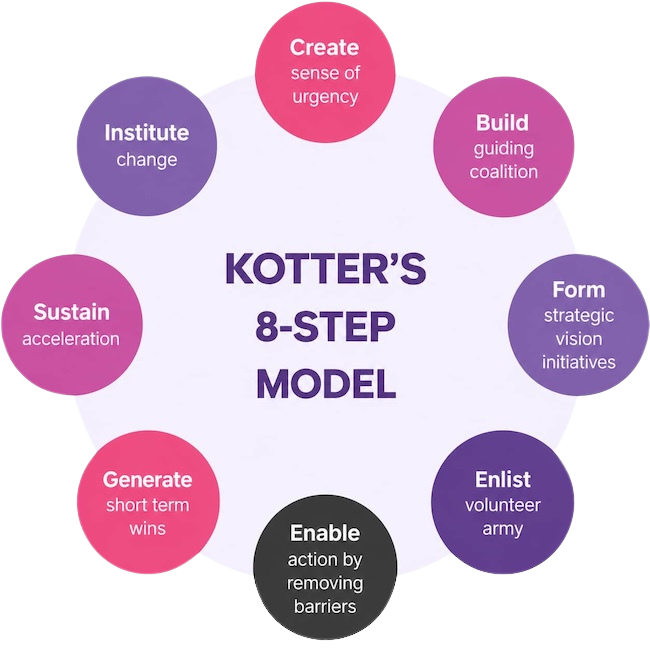
Organisational change rarely succeeds because someone announces a new plan. People need to understand why the change matters, what it means for their work and how progress will be supported. Kotter's 8 Step Change Model offers leaders a practical structure for turning a proposed change into action. It highlights the role of urgency, collaboration, communication and reinforcement.
The model can help when an organisation needs a shared approach, but it is not a substitute for listening to the people affected. Used well, the steps provide a set of questions for leaders to work through rather than a rigid checklist to complete once.
What is Kotter's 8 Step Change Model?
ohn Kotter developed an influential framework for leading organisational change. The model identifies eight activities that support momentum, from helping people see the need for change to embedding new ways of working. Its original presentation was sequential, although many organisations use the principles more flexibly in practice.
The value lies in recognising that a technically sensible plan can still struggle if people do not believe in it, understand it or have the means to act. Change involves behaviours, relationships and trust as much as project milestones. Leaders therefore need to manage both the practical and human sides.
The eight steps explained
1. Create a sense of urgency
Explain what is changing and why acting now matters. Use clear evidence and a credible picture of the risks or opportunities. Avoid fear for its own sake; people are more likely to engage when the reason is honest and connected to their experience.
2. Build a guiding coalition
Bring together people with influence, expertise and credibility across the organisation. This need not mean only senior managers. Frontline employees can identify barriers that a project team may otherwise miss. The group should be able to make decisions, listen and sustain attention.
3. Form a strategic vision
Describe the future in language people can understand. Explain what will be different for teams, customers and everyday work. A strong vision provides direction without pretending every detail is already known. Link it to a small number of clear initiatives.
4. Enlist a volunteer army
Invite people to contribute ideas, champion the approach and share feedback. Engagement is stronger when employees have genuine opportunities to shape implementation. Do not confuse enthusiastic announcements with meaningful involvement. Ask who is missing from the conversation.
5. Remove barriers
Identify what prevents progress. Barriers may include unclear authority, competing priorities, inadequate systems or managers who have not had the right support. Removing an obstacle is often more useful than asking people to work harder around it.
6. Generate short-term wins
Create visible, credible signs of improvement. A small pilot that solves a real problem can build confidence and provide learning. Celebrate results accurately, without overstating them or ignoring remaining issues. Use wins to show how the change benefits people.
7. Sustain acceleration
Early success can create a temptation to declare the job finished. Keep reviewing what has changed, what remains difficult and which systems need further adjustment. Apply lessons from pilots, continue listening and maintain leadership attention as the work expands.
8. Institute change
Make the new ways of working part of ordinary decisions, expectations and development. That may involve onboarding, measures, processes and the behaviours leaders reward. A change becomes durable when it no longer depends solely on the original project team.
Where the model works well
Kotter's 8 Step Change Model is useful for organisation-wide initiatives that require coordinated action. Examples include adopting a new service approach, integrating teams after a restructure or changing how leaders manage performance. It can also help a senior team organise the communication and engagement work that might otherwise be overlooked.
A significant strength is its emphasis on people, not only schedules. It encourages leaders to make the case for change, involve others and keep reinforcing progress. The clarity of the eight stages also gives teams a shared language for discussing what has been missed.
Strengths and criticisms
Kotter's 8 Step Change Model is easy to explain and can expose common gaps, especially where leaders have focused on technical implementation but neglected buy-in. It offers practical prompts for building sponsorship and maintaining momentum. However, its step-based presentation can appear too linear for complex or fast-changing situations.
Critics also point out that not all change begins with a dramatic crisis or a single leadership-led vision. Teams may need to experiment, adapt and revisit earlier decisions. Strong top-down communication will not compensate for a lack of genuine participation. Consider Kotter a guide, not a universal recipe.
How leaders can use it in practice
To put Kotter's 8 Step Change Model into practice, start by identifying where your initiative currently struggles. If employees cannot explain why it matters, revisit urgency and vision. If they understand the plan but cannot act, examine barriers, capacity and decision rights. If early improvements are fading, focus on reinforcement and management habits.
Make room for uncertainty. Talk to different teams about how the change affects them, acknowledge trade-offs and revise your approach when new evidence appears. The Colour Works explores these human factors through its Leading Through Change workshops, including responses to uncertainty and the conversations leaders need to have.
Helping change last
Successful change is judged by what people do differently, not by whether every stage has a tick beside it. Review results, ask for feedback and notice how managers behave when circumstances become difficult. That tells you whether the new approach is becoming part of the culture.
Developing this ability takes ongoing practice. The Colour Works offers leadership development and team development that connect self-awareness and communication with real workplace challenges. Use Kotter's model to structure the journey, while staying curious about the people who must make the change work.