

Leadership Lab Ep4 - Would You Follow You?
By The Colour Works on Aug 12, 2026
Leading with High Standards: The Role of Values, Authenticity and Self-Awareness
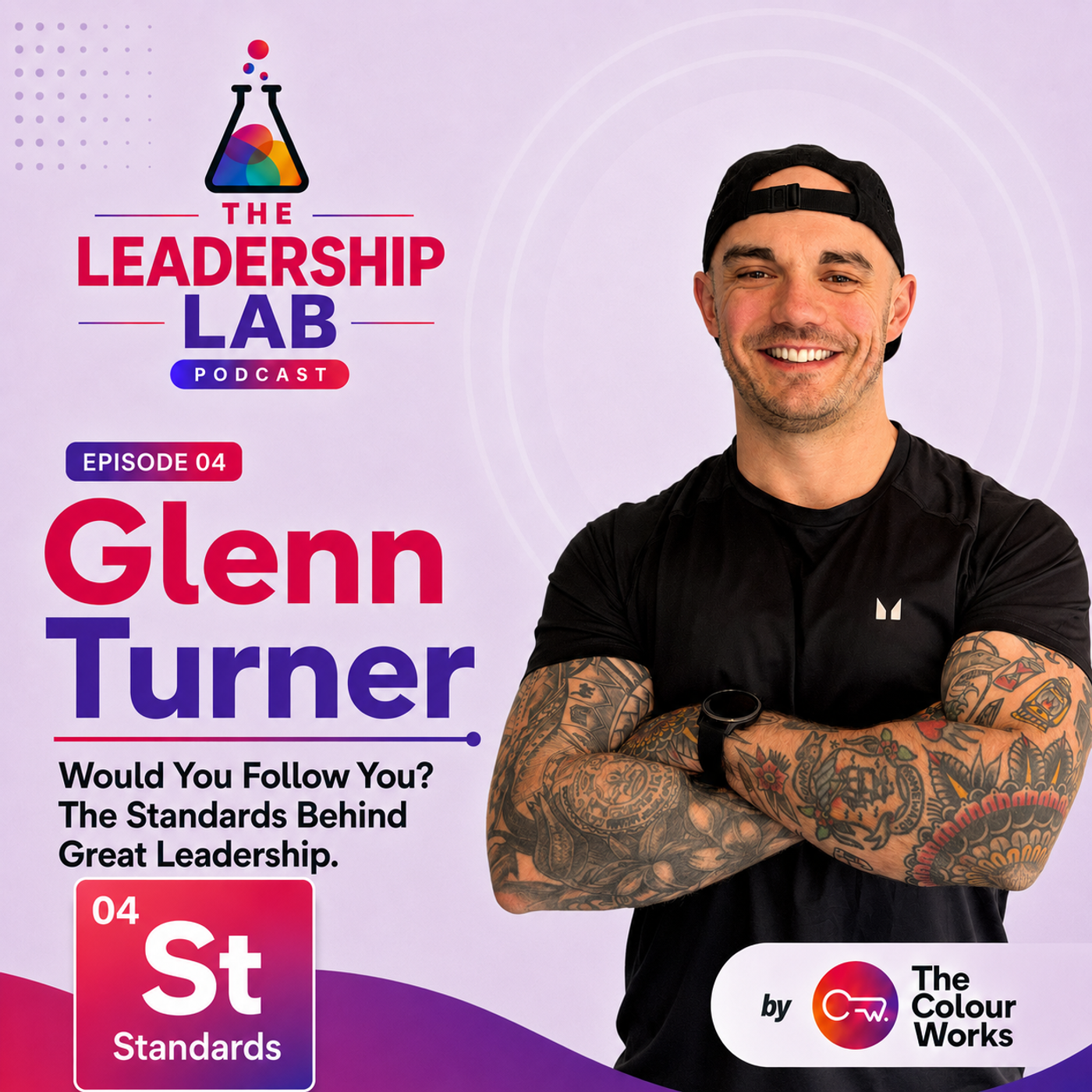
In this episode of Leadership Lab, Glenn Turner shares his leadership journey, exploring how high standards, authenticity and self-awareness have shaped the way he leads and works with others. Drawing on experiences across hospitality, learning and development, the corporate world and fitness coaching, Glenn reflects on how personal values influence leadership style and the importance of setting and maintaining standards with empathy.
At the heart of the conversation is an important leadership question: how do you maintain high standards without losing sight of the people you're leading?
The Power of Clear Values and High Standards
One of the standout themes from Glenn’s story is the impact of clear values within an organisation. He shared his experience working for a hospitality company where the founders instilled a strong culture of accountability and passion among the staff. This not only fostered a supportive environment but also encouraged employees to strive for excellence.
Glenn emphasised that when everyone in a team believes in the same values, it can lead to better performance and a shared commitment to quality.
Our standards are often closely connected to our personal values. They influence what we expect of ourselves, what we expect from others and what we consider acceptable.
For leaders, high standards can be a significant strength. They create clarity and help people understand what good looks like. However, leaders also need the self-awareness to recognise that the standards that feel natural to them have been shaped by their own experiences, motivations and values.
This raises some useful questions for leaders:
- Are my expectations clear to other people?
- Do I demonstrate the standards I expect from others?
- How do I respond when somebody doesn't meet those standards?
- Are my standards helping people perform at their best, or creating unnecessary pressure?
Balancing High Standards with Empathy
One of the most interesting tensions explored in the conversation is the relationship between high standards and empathy.
It can be tempting to see the two as opposites. If we're empathetic, do we risk lowering expectations? If we maintain demanding standards, do we risk appearing unsympathetic?
Effective leadership requires both.
Empathy allows leaders to understand the individual behind the performance. High standards provide clarity about what is expected. Combining the two creates an opportunity for accountability alongside genuine support.
High standards without empathy can create fear. Empathy without standards can create ambiguity.
Understanding someone's circumstances doesn't mean removing accountability. Instead, it can help leaders understand what someone needs to reach the required standard.
Rather than immediately asking why somebody hasn't performed, leaders can become curious. Is the expectation clear? Do they have the skills and resources they need? Is something getting in their way? What support or challenge do they need from me?
This doesn't lower the bar. It can help people understand how to reach it.
Authenticity and Self-Awareness in Leadership
Authenticity is another important theme in Glenn's leadership journey.
People are more likely to trust leaders when there is consistency between what those leaders say, what they value and how they behave. Authentic leadership isn't about adopting a particular leadership persona. It is about understanding who you are and being conscious of the impact you have on others.
That is where self-awareness becomes so important.
Leaders need to understand not only their strengths but what can happen when those strengths are overused.
A strong drive for quality, for example, can inspire excellence. Taken too far, that same drive might be experienced by someone else as perfectionism or unrealistic expectations.
Confidence can provide clarity and direction, but overused it might leave less space for other voices. Empathy can build strong relationships, but without appropriate challenge it could make difficult conversations easier to avoid.
Self-awareness allows leaders to recognise these patterns and adapt their approach without compromising who they are or what they stand for.
A useful question to ask is:
Is the impact I'm having the same as the impact I intended?
How Leadership Standards Shape Team Culture
The standards leaders set don't only affect individual performance. Over time, they help shape team culture.
People notice what leaders recognise, challenge and allow.
If poor behaviour is repeatedly overlooked, it can gradually become accepted. Equally, if expectations are impossibly high or mistakes are treated harshly, people may become reluctant to experiment, challenge ideas or admit when something has gone wrong.
The way standards are upheld therefore matters as much as the standards themselves.
Leaders can maintain accountability without creating fear by being clear about expectations, consistent in how they apply them and curious about what has happened when somebody falls short.
Creating an environment where someone can admit a mistake doesn't mean removing consequences or accepting poor performance. It means creating the conditions for honest conversations, learning and improvement.
"Your leadership standards are dictated by the standards that you set for yourself."
Glenn Turner
Lessons from Glenn's Leadership Journey
Glenn’s journey took a significant turn when he faced redundancy just months before becoming a father. Instead of succumbing to fear, he chose to leverage this challenge as an opportunity to launch his own business.
Throughout his career, Glenn has also prioritised continuous learning, pursuing a CIPD Level 7 qualification in learning and development and demonstrating his commitment to understanding leadership at a strategic level.
His journey across hospitality, corporate learning and development and fitness coaching provides an interesting perspective on leadership. Different environments may require different approaches, but the importance of understanding yourself, being clear about your values and recognising your impact on other people remains.
Glenn also highlighted the importance of community. By surrounding himself with inspiring individuals and leveraging networks, he has been able to grow both personally and professionally.
Colleagues, mentors, coaches and trusted peers can also play an important role in developing self-awareness, helping us see patterns in our behaviour that can be difficult to recognise ourselves.
Lab Notes
Key Takeaways
- High standards can be a leadership strength. They provide clarity and help teams understand what good looks like.
- Values influence how we lead. Understanding your personal values can help you recognise where your standards and expectations come from.
- Empathy and accountability can coexist. Understanding someone's circumstances doesn't mean lowering expectations.
- Authenticity helps build trust. Consistency between what you say, value and do creates credibility.
- Self-awareness makes leadership more intentional. Understanding your strengths, preferences and impact gives you greater choice in how you respond.
- Standards shape culture. What leaders demonstrate, recognise, challenge and tolerate influences the behaviour of the wider team.
- Leadership is an ongoing journey. Experiences, challenges and relationships all provide opportunities to learn and grow.
You May Also Like
These Related Stories

Leadership Lab Ep2 - The Curious Leader

Leadership Lab Ep1 - The Power of Listening and Dreaming Big!